Header

Header

Tuesday, August 14, 2012

Cda 3.0 "Overcoming"

Race start, Wave #2.  I am the one in the white cap and black suit...with goggles.
Photo by James Richman

Before I even start this post, I must give credit for the pics to the generous people, with their talent and time, who took them.  Without them, this blog post would be, well, boring.  Thanks to James Richman, Bryan Rowe, and Tanya O-Keefe.  Great pics, and ones that I could not have taken myself…for obvious reasons.

This post is mainly about the Cda Scenic Challenge triathlon.  One which I have written about on a few occasions.  The 2011 post HERE, the 2009 HERE, 2008 HERE). This event is near and dear to me.  It always seems to teach me something…something that I must overcome in some facet or another. It challenges me physically as well as emotionally.  I feel so much pressure when racing this event... not from others, but from myself.  I try and downplay it, but no matter what my fitness level, I have never been able to go into it saying, ‘Ah, it’s just another race and I want to have fun.’  I think it’s the history from the first time I raced it.  I have raced 3 different courses here.  And no matter the course, it has always been a challenge on multiple fronts.

1997- My first Oly tri.  Just get it done…and I barely did.
1998- I was done with my triathlon season in June.
1999-2002 No triathlons at all.
2003- I was sick, and wondered why I was even there.  Suffered through but wasn’t happy.
2004- I was racing well, but never really did ‘well’ at Cda. This year I ended up 2nd overall to Matt Seeley, and the first time I beat Cda uber triathlete Brian Hadley.
2005- I was at Nationals, which was cancelled the day of the race.  I tried to fly home to race Cda…but couldn’t make it happen.
2006- Focus was on IM  Canada and Kona and did not race.
2007- Focus was on IM  Canada and Kona and did not race.
2008- I was in great form, but fell apart late in the bike after a few mishaps. (Later to find out that I was under-fueling on all Oly races).
2009- Nailed it.  First time I won Cda Tri.  This was the greatest ‘personal’ race for me.
2010- Did not race any triathlons because I was hit by a car in May.
2011- Training was focused more on family.  This would be a test to see what would happen when triathlon was a 3rd tier priority.  Result, overall win.  Crazy.
2012- read on…

This year would be no different than the other years…a few hurdles before the race even started.  Of course, the one mentioned in the prior post (HERE) regarding the vertebral dissecting artery, and to add to that, I strained my calf the Sunday prior.  As a result, I did not run at all the week and focused recovery which included 2 massages at Elements Therapeutic Massage, icing, heat, electro stim, stretching…you name it.  It was a part of the training each day.  The question was, would I even be able to race?  Even the day before the race I was limping around a bit favoring the calf.  I did a little pre race run, just to test it a little for about 5 minutes, and determined that it bothered me a little, but didn’t seem to as much at harder efforts.

Race day I woke at 4:05 am, and the calf was definitely tight, and a little sore.  But as I walked around a little, it seemed to feel a bit better.  I was counting on a swim and bike to help with blood flow to loosen it up to run.

I got to the race site at 5:30am.  Found a spot on the rack, and placed some of my stuff there.  Immediately I realized I was next to someone I knew and we chatted a bit.  Then I saw Brad Vanwert, a local legend and USAT official, and chatted with him a bit about races, bikes, airplanes…really just about everything.  I told him about my calf and he gave me some really good advice…don’t race.  I figured if my calf acted up, I would stop.  I saw so many other people there, that I had to catch up with, before the race.  I eventually had to get ready and sort out my transition area.
Not the most organized Transition Area...better work on that

This race has 3 different start times: 39 and under, 40 and over, and teams/Clydesdales.  They are all separated by 10 minutes.  Since I am an old guy, 40 years old, this meant that I started at 7:10.  To me, this is a nice spot to start.  Though it is a little congested on the swim, once I start catching the wave ahead, it’s fun to see other people out on the course, e.g. the bike.  It also gives me an idea as to where the competition is.  As long as I could keep the gap less than 10 minutes by the end, I would be ahead.

I pulled from my bag my brand new B70 Helix…still in the plastic bag.  I know, ‘never try something new race day,’ but I have raced in this suit for years.  Why not?  I noticed there has been some significant changes to the suit over the past few years…I was hoping they would help me.

Pre Swim in my new B70 Helix.
Photo by Mike Winnett

I rolled down to the start and got in a 1 minute warm up…pointless really.  I looked around to see some familiar faces.  With goggles and swim caps, it is tough to spot ‘familiar faces.’  But I did see one.  Gulp.  Matt Seeley.  Matt is a legend.  2nd at IM Cda and countless other high caliber victories.  He is a true competitor and ALWAYS a favorite in ANY race he does.  Back in 1997, the first year I did this race, he won it.  We are 1 year apart in age, so would be racing in the same 40+ wave.  Cool.  I was bummed I was not in top form to test myself against him, but I doubt he was either.  I knew he was having some foot issues, but injured or not, unconditioned or not, he is always ready to race.

The gun went off and we swam.  It was pretty uneventful.  I started to drift off mentally from time to time and then I started running into slower swimmers.  I knew I was near the front of my wave, but needed to swim hard since I had not been in the pool too much the past 3 months.  So even ‘hard’ would result in a time that I would not be too excited about.  I ended up swimming a 22:21, yikes, a tad slow for my liking (it did include a short run to T1).  

 Exiting the swim into T1
Photo by Bryan Rowe

Focused
Photo by Ryan Rowe
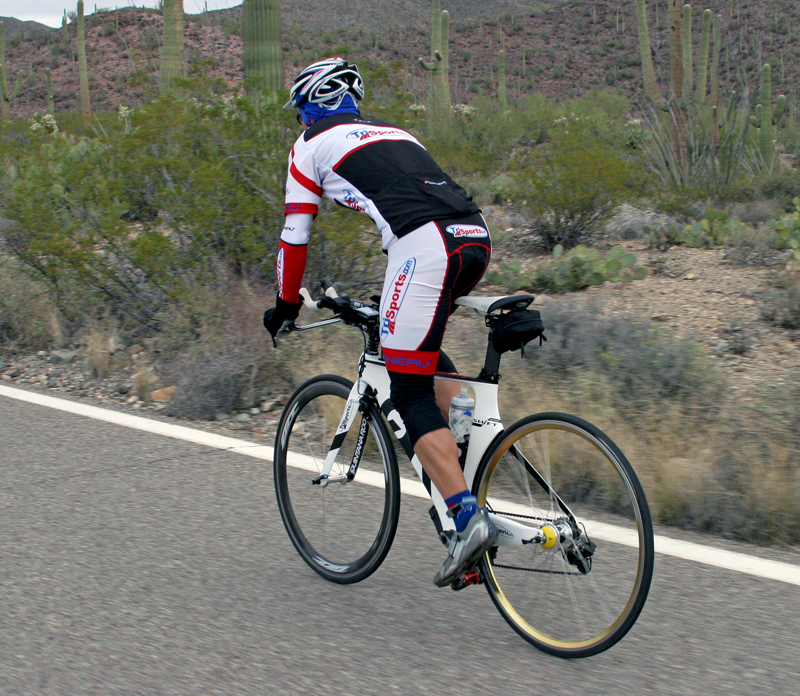
I transitioned quickly and threw on my Rudy Project Wingspan, and was off.  When I got to my bike, I could see Matt Seeley leaving T1.  ‘Nice, not too far off.’  But Matt can ride with the best of them…literally, the best.  I took off out of T1 and could see him up the road.  I was actually closing on him on the flats bringing him within 4 seconds.  Then we hit the first climb.  We stayed close, but he was eeking away.  At the top, he pulled over to adjust his front brake.  I figured that’s why I closed on him, his brake was rubbing.  I stayed in front for a couple miles, until, the next major climb.  There he passed me again and slowly put more and more time on me.  For some reason, on all the flats and down hills, I would bring him back.  But I never did pass him.  I assumed it was my Quintana Roo CD0.1.  Pretty dang aero.  At the last turn around, I saw that I was still pretty close.  I was also able to see the guys in the first wave and took some splits on them.  I figured we closed about 3 minutes on them, so Matt was in 1st, and I was in 2nd…but they likely did not know that.  As we came into T2, after about a 4 mile flat section, I was only 10 seconds, or so, behind Matt.  Later to find out I had the fastest bike split of the day for individuals.  Cool.

Coming out of T1...left foot still not in my shoe yet
Photo by James Richman

 The end of the bike
Photo by James Richman

Matt took off from T2, and I was near…like 6 seconds or so.  T2 is always fast.  The only hurdle is if your feel easily go in your shoes or not.  This time they slipped into my K-Swiss Kruuz like morning slippers, and I was off.  I ran at the same pace as Matt for about 1 mile.  Then it happened.  My calf ‘popped.’  Crap x2.  I immediately backed off, went to my heels, shortened my stride, and favored it for a bit.  The sharp pain went away and turned into a dull ache.  ‘I can run on this,’ I thought.  That is what I like about Oly races.  You normally don’t notice things that would normally make you stop…like hot spots on your feet…or a rock in your shoe.  You just keep going and if you notice that pain, you just go harder so the pain is somewhere it matters, like your legs.  I hit the first aid station and felt like I raped them for water.  One person handed me a cup, so I reached and robbed a couple more people.  I kept plodding along and watched Matt pull further away.  I was never really concerned about Matt.  I can’t run with him.  He is a phenomenal runner.  I was more concerned about who was behind me and how far the first wave was ahead.  I got a few splits and realized we were into the first wave about 4 minutes.  So at the turnaround, I figured they would have to run 4:50s or so if I maintained the same pace.

Finish stretch
Photo by James Richman
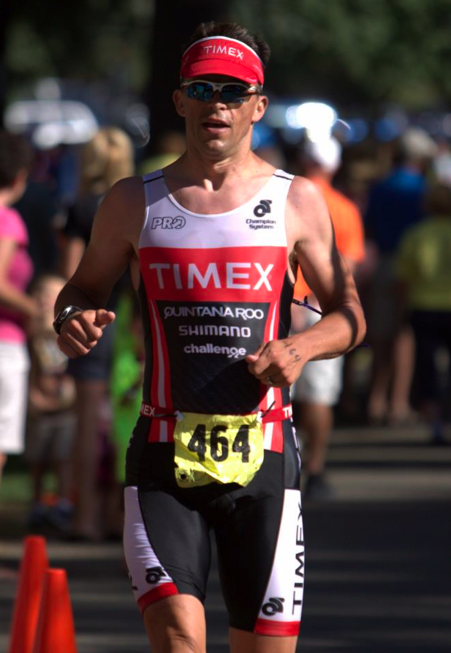
Finish stretch
Photo by James Richman

I ended up finishing 1:03 behind Matt.  Not too bad all things considered.  But no matter what place you get, 1st to 2000th, you have to look at ‘your’ race.  Did you do what you wanted?  Did you control what you needed to?  Did you meet your goals?  I really did not know what to expect on this day.  My bike and run were faster than last year when I won.  My overall time was as well.  So does that mean that I am in better shape now?  Not likely.  My swim was sub par.  My bike felt good, but I have not looked at, or compared, power numbers.  I suspect that my Quintana Roo is simply ‘faster’ than the Orbea was…aerodynamically speaking of course.  Over 1 hour, it does add up at 25 mph.  My run was a little faster this year, but the course was a tad different.  Just a flat out and back.  So it is comparative…but not truly the same.  Bottom line, a decent effort and I was surprised with the result.  Happy with it too.
Now that is one big mug.  Great for iced coffees I suppose.

I can’t say I was out there alone.  I had a lot of cheers that kept me going and Jessi, Emma, Owen, Greg, and Natalie were following the race a bit.  I saw a ton of familiar faces, and heard voices out there too.  Always a little push.  Weeks leading up to these 'emotional' races seem to require a bit more from my family...especially Jessi.  She is so in tune with me, and does everything right.  I am so fortunate to have a wife that knows me and supports me in what I do.  Also, my mom.  She normally gets put on 'Owen Duty,' which she says she loves.  But I know she does it just as much for me as well.

 
Owen and me post race
Photo by Tawnya O'Keefe

So, what was the hurdle?  This was a race that I was truly not too sure if I would even be able to finish because of the calf strain.  A calf strain isn’t an injury that you can just ‘power through.’  So the days leading up were uncertain and I was so close to throwing in the towel.  The ’09 win was accomplishment.  The ’11 win was about prioritization (family first). ’12 second place was about accepting the unknown and still race like you know.  That goes beyond the calf, but to my fitness level and the hurdles with the paralysis in my right arm and the vertebral dissection.  A little more complicated.  I am not some unique or special story, we all have hurdles and other parts of our lives that create challenges.  The ones we know about, we can generally manage.  It is the ones that hit us from the side, or from behind, that put us on our heels and make us juggle things.  Then comes the subsequent problem, or question, ‘What should I do now?’  Rarely are things ever perfect…but they can always be worse.

Next race on the schedule will be Priest Lake Triathlon.  Hopefully my calf will be back to 100%...or even 80% would be good.

Saturday, July 28, 2012

MRIs, Coumadin, Dissecting Arteries, what else?


Through each year, it seems that I learn something about myself that I never knew prior.  Sometimes it is about pain, power thresholds, prioritization, equipment, races, etc.  Then there are years you find out ways around things like injuries (being hit by a car), family health needs, vacation…you know, ‘life.’  Then there is this year… the year when a curveball came and really stumped a lot of people.  Very few know the whole story. Those that do, were likely stuck with me in car for a long time, and unfortunately asked the question, “So what happened?”

Here is the gist (I laugh when I say that because there is no ‘gist.’  It’s a friggin’ story).  A couple months back I went to our 6th grade campout.  After getting off the bus at camp, my right shoulder area hurt quite a bit…kind of like a pinched nerve.  I figured it would work itself out.  After 4 nights of not being able to sleep very well because of the discomfort, I decided to schedule an appt with Dr. Brian Mather, my chiropractor for the following Monday.  Rolling into that Sunday prior, I showed up to our Master swim group and noticed that my right arm felt fatigued…kind of like I just had swum 6000 yards with XL paddles.  Kind of like my arm was 2” longer…or like I had been carrying an arm full of firewood for 2 miles.  You get it, right?  During the swim I noticed that I was compensating quite a bit…pulling harder with my left arm and kicking a lot more.  Not good for technique, but I was making the send offs.  Afterward, I just figured it was something in my back and I would be seeing Brian the next day.

Monday rolls around and I go to grab my first cup of coffee for the day and I can hardly reach up to grab a cup from the cupboard.  Dang, this isn’t good.  The whole day at work I was massaging my shoulder trying to figure it out.  That afternoon I met with Brian.  He made a few adjustments and ran me through a slug of tests for ALS, MS, etc.  He wasn’t sure what was going on; the symptoms just did not seem to add up.  I asked if I should see my general doc., and he said they would likely get x-rays…find nothing…then order an MRI and put me on prednisone.  Guess what, he was exactly correct.  BUT, the MRI would help rule things out, right?  Gulp, nope.

On Thursday I had an appt. for my MRI as well as an appt. with Brian immediately afterward.  At this point, I could no longer lift my arm.  What little I could move it, I had no strength at all.  Nothing hurt, I just could not move it any higher than about 45 degrees.  At about 2:00 pm, I went in to get my shoulder and neck MRI.  Before I did, I had to get injections…i.e. needles.  Deep breath.  The doc. administering the injections was a parent of a student I had last year.  I was trying to remember what grade he got…I guess I would find out based on the pain.  After the injection I went into the ‘tube’ fairly soon afterward.  I got the directions for what was going to happen. The tech told me at the start that I would have a safety button that I could push if I ever felt uneasy.  ‘What, me uneasy?  Come on, how tough can this be?’  As I was lying down on the platform, and was slowly being pushed in to the small mouse sized tube, I asked, ‘How long am I going to be in here?’  He replied, ‘Oh, about an hour.’  I immediately felt my heart rate increase, and nerves start to go awry. As I was in there for about 10 seconds, I opened my eyes and immediately felt like I could not breathe.  I was going to die for sure at this point.  I reached for the button thinking I needed to press it.  My legs were getting tingly, I was feeling cold…in other words, I was about ready to pass out.  I closed my eyes and started to think about other things.  What was Jessi doing right now?  Does Emma have swim today?  When is her next swim meet?  I immediately calmed down and did not press the button.  Whew.  But thinking about my family and what they were doing would only consume a few minutes.  I needed to think of other things.  Something LONG that would take some time to retrace.  Okay, Ironman.  I decided to reflect back on my first IM that I did in Cda.  The one that I flatted on the bike and walked/ran the marathon.  What could be longer? That got me though most of the MRI, so I had to throw in a couple sprints at the end as well.  Whew, done! After that, I like said earlier, I had a chiro appt. with Brian.  I headed straight there where he would have the results of the MRI I just finished.  I was excited to find out what was going on.  Little did I know…

I arrived a little late so I chilled in the massage chairs while I waited since they pushed me back a smidge.  Brian came out and said, “Let’s see what we’ve got.”  He looked over the MRI first identifying some early signs of arthritis (common) and some discs that looked a little thinner.  All in all, nothing that would suggest anything crazy.  THEN he said it was time to read what the radiologist’s report said.  Cut to the chase, it said that I had a dissecting vertebral artery between the C4 and C5 (neck).  Gulp, what does that mean?  Simply put: Arterial dissection refers to the abnormal, and usually abrupt, formation of a tear along the inside wall of an artery. As the tear becomes larger, it forms a small pouch which doctors call a “false lumen.” The blood that accumulates inside this false lumen can lead to a stroke.  Brian said that it was a little out of his wheel house, so he called the best sports med doctor around, Dr. PZ Pearce.  He said that if it was truly a dissecting artery, I needed to contact Dr. Madeleine Geraghty down at Sacred Heart who is a phenomenal vascular neurosurgeon.  So, that’s what Brian did.  After that, she said that I needed to get down to the Sacred Heart ER and get admitted for full brain MRI.  The concern was that the dissecting artery could have caused a stroke, which would explain the paralysis in my right arm.  Still, no good news.  I felt like a ticking time bomb.

As I left Brian’s office, I started to feel really concerned.  Could I all of a sudden ‘stroke out?’  Is this how it ends?  Will I make it to the hospital?  Just then, I saw a group of Tri Fusion members out on a run, and there was Jessi.  I stopped ahead of them and tried to calmly explain what was going on.  Hmm…how do you quickly and calmly communicate something with such urgency?  Fortunately we have such great people in our lives and things just fell into place.  Owen and Emma were immediately covered, and Jessi and I were off to the hospital.

Heading into the Stroke Unit at Sacred Heart just did not seem right.  I mean, I am only 40.  Am I that old?  Upon arrival to any ER you are greeted by some of the community’s finest injured people.  People who are convinced their life is over with the sprained ankle…or their pro basketball contract is out of reach now because of a jammed finger.  And for some reason, they need to be in a wheelchair as well…for a finger.  I started filling out the paperwork and before I finished, they called me back.  I was immediately set up in a trauma room.  IVs being plugged in and electrodes all hooked up.  I guess I was pretty safe now.

After introductions, I discovered that the ER dr. knew me from…get this…Strava.  If you don’t know what Strava is, think of it like Facebook for cyclists.  So we chatted about some routes and stuff bike related.  Kind of comforting knowing that he was a cyclist and knew me as a cyclist, though an injured one, rather than some random 40 year old potential stroke patient.

It was time for the brain scan MRI.  This MRI is even more accurate than the other MRIs I had earlier in the day.  It takes micro images of my brain.  I have to say some big concerns were racing through my mind.  Was this how it ends?  Is this where they find the golf ball sized tumors and Matchbox cars?  This MRI went a little better.  For some reason I was not as nervous.  Not to mention, the guy was talking to me the entire time letting me know how long each section would take.  Before too long, it was over…about 25 minutes.  Then it was back to my ‘trauma’ room to wait for the results.

As I entered the room, Jessi was there waiting and had contacted all the necessary people…parents, close friends, etc.  I did not feel that this was a “Facebook” status update item… sorry.  I really did not know what was going to come of it.  Mark Hodgson, best friend since 5th grade, was obviously getting antsy at home, so he came down with Arby’s for dinner.  Dang Arby’s food is ‘good mood food.’  I could not eat any of it at that point because we did not know what the next step was.  Possible spinal surgery?  Brain surgery?  Who knows.  Then I saw an older man come strolling in…the neurologist.  Gulp.  Deep breath.  I asked him light heartedly, ‘So, was there a brain?’  He said, yes.  I asked how it looked and he said it was fine.  I said, ‘Define ‘fine.’’  He said it all looked great, nothing to worry about.  Whew, good news finally.  He thought he had it all figured out, until I explained the sequence of events, again. Then he was stumped.  Eventually he retired to say, regardless of why your arm does not work, we need to address this dissecting artery.  He also said that I would be the topic of conversation the next morning at the neurologists’ team meeting.  Is that good?

After the news from the neurologist, I felt pretty good.  My right arm did not work, but my overall health was good and ‘hopefully’ this would all work itself out.  Though we were tired (it was 11:30pm) I felt a new sense of energy.  It had been such a downward spiral this afternoon, it was nice to have it belly out and regain control.

The next day started the onslaught of appointments.  First was with a vascular surgeon.  That was fun.  Ultimately I learned that though I was on coumadin, he said I needed to be on Lovenox (big ass shots) until my INR (blood viscosity) was stable 2x thinner, or, taking 2x as long to clot.  I hate shots.  I would need one in the morning and at night for a week.

So, since May my life has been about appointments, drugs, blood, and doctors contemplating what in the world was going on.  I can’t complain though.  It’s only ‘part’ of my right arm.  Could be worse.

As for the training, I have been able to ride a little.  But without full strength in the arm, it is kind of like riding with a broken collar bone.  I am also not too keen on crashing anyway, but if I did, I would have to deal with thinned blood.  So I rode 1x a week…short and easy.  Running was actually more difficult than you’d think.  When you run, your arms are naturally supported with muscles to hold them up, and allow them to swing and control the swing.  Without essentially 3 muscle groups working, others had to work in ways they normally don’t.  So I would suffer extreme muscle fatigue when running.  I felt like I was shaking out my arm every 5 minutes.  It has all been crazy figuring out what you can do and what you cannot.  Swimming has been different.  The first time I tried to swim, it almost made Jessi cry.  It was really weird.  I could get my arm out of the water, but once it entered, it could not resist the force of the water.  So it just got pushed back. Pretty much a worthless stroke.
Since the diagnosis I have been testing my arm each day seeing if it works better.  I ask Jessi “Does this look better?” many times a day.  Normally she just shrugs her shoulders and says, “Not that I can see.”  In the last 2 weeks I have regained a lot of range of motion though.  Not too much strength, but I can actually lift my arm above my head.  Pretty exciting.  So in about 2 months, things are starting to work again.  I feel like I am ahead of the curve.  Swimming is better.  Longer stuff (200s) is difficult because I have no endurance right now.  I feel like that it will only get better.  ‘Fast’ is not there though.  Cycling has increased since our 10 day trip to the coast, and running is getting better too.  So with a couple weeks of training now, I feel like I am slipping back into ‘training.’  Phase one.

Through this process, I had a lot of people ask about racing.  The most common question being, “Aren’t you bummed right now that you cannot race?”  Racing really was the last thing on my mind.  The fact that I could not pick up my kids, was waaaay more important.  Maybe it’s because I have raced a lot so the novelty it gone... don't take that the wrong way.  But the little things that you do day to day are far more important to me.

So what’s next?  Immediately, I plan to race our sprint regional championship this weekend (July 29th).  I am pretty excited about that.  It is a fun race and one that I have done in past years.  There will be some tough competition there, but it is really more about getting out and racing than it is trying to eek by someone and puke at the finish.  The benefit to this race is it is a current aided swim.  That means if I am unable to finish the swim, the current will take me to the finish regardless.  Cool huh?  After that, I will likely race a few more Oly races and end the season with a 5150 or Lifetime Fitness series race.  Still contemplating that currently.

You never want something like this to happen, but inadvertently it usually does.  I am so fortunate to have the support I do.  Jessi has been so amazing and understanding and level headed about this.  Never freaking out and looking at the worst.  I have also been so fortunate to have amazing people in the medical field that were, and have been, looking after me. I cannot imagine if I didn't have Brian Mather in my corner. A huge thank you to all my friends and family who have been there from the start asking how they could help.  It has made all the difference in the world.  I do not understand how people who live away from family can handle these situations.  I really feel blessed.

Sorry for the long blog, if you are still reading, nice work.  Believe it or not, this was the short of it.  Now you are all caught up.

Keep riding,
Roger

Wednesday, March 14, 2012

Building the QR Illicito

I say this time after time after time. No one does anything in triathlon by themselves...no one. That statement applies to the assembly of my new Quintana Roo Illicito as well. Many hands in the pot.

It started on March 5th, when my QR Illicito arrived, along with my Shimano Pro Missile EVO bars and stem. I love BOXES...especially when they are on your front porch. In the boxes are 2 products that are not that 'available' which means 2 things. 1) Cool factor. 2) Not too many people will be able to help you if you run into a problem. I'm ready...open the BOXES!

Boxes. All good things come in boxes...like donuts


Nice internally routed for Shimano di2

Finally in the shop!

Shimano Pro Missile EVO and EVO stem

I will try and not get too 'technical' with things, but still give you a taste of the excitement in building this bike. Before building any bike I like to have all the "small parts." And trust me, as TT bikes get more and more technical, there are always parts you need that you don't have. Fortunately, Brad DeVaney at Quintana Roo, and his phenomenal staff (Tres in particular), answered a slew of questions and made sure I had all the 'right' parts. I am very fortunate to also have Fitness Fanatics here in Spokane too. They carry QR and always lend a HUGE helping hand.

After taking 100 measurements, and looking at spec numbers over and over, it was time to stop pussy footing around and start building. First things first... cut the fork. That way I can get the Pro EVO stem on and then everything else falls into place so to speak.

Here we go...

I was only able to allocate an hour or two per day building this bike. I know, normal bikes would be done in that amount of time. But routing Di2 internally and through stems and aero bars is a little more time intensive. AND this where I ran into my first hurdle. The front Di2 wire harness I have, is from when Di2 first came out. It is slightly different than the ones today. Because back then (yes, a whole 3 years ago), aero bars and frames were not designed for di2 to be internally routed. Short of it is, the wires did not reach the end of my aero bars. Crap. This is where you take a deep breath and hope for a simple solution. I called Shimano and explained my situation, and 2 days later, wires showed up in the mail. AWESOME! But not just any wires, the RIGHT wires. Now I was ready to roll. My BB30 bearings were pressed in, I threw on the BB30 to standard adapter, and we were off and rolling...not really, more like looking at a frame and fork in a stand.
I could not stop staring at this stem/bar combo

The whole process was pretty simple. But since I did everything 2 or 3 times, it took me a bit longer. When you route housing through a stem and the bars, you only want to cut it and grind it once. Pulling it all through again and re doing it is so frustrating and a waste of materials. And with Di2, you pull a wire too hard, or press/pull against something sharp, cha-ching...$200. I also took some extra time sitting on the shop stool admiring the beauty of the bike. I seem to find myself doing that a lot. It really does not matter too much what kind of bike, I just like looking at the design of it all thinking of all the punishment and abuse that will be had on the steed.

Time to play.

The left side...minus a seat stay

The cockpit.

Drivetrain

Nice butt

Where did it go?

Clean front end

SRM and Di2. I'll have that.

Illicito...this is why

Thank you to Jessi and my family for putting up with me the last week. I know Jessi can only absorb so many stories about how cables and wires are run through a stem and bars and little tricks I have found. She brought me a few coffees and even dinner once.

Build:
Quintana Roo Illicito frame- Large
Crank: Dura Ace 7800/7900 SRM 42/54
Pedals: Look Carbon Keo
Base Bar/Aero Bar: Shimano Pro Missile EVO
Brakes: TRP
Rear der: Shimano Di2
Front der: Shimano Di2
Brake Levers: Shimano Di2
Shift Levers: Shimano Di2
Chain: Shimano 7900
Cassette: Shimano 7900 11x23
Wheels: Shimano Dura Ace C50 Clinchers


Wednesday, March 07, 2012

Interesting USADA Testing Information

So, I have made some random statements from time to time about drugs being in all sports, but it's cycling that gets all the media attention because of how much they are tested. Take it or leave it, I still believe that to be true. I believe there is a problem in all sports, but again, cycling gets all the attention.

It must be because the cycling world is so fond of using drugs. Being on the bike just demands a needle in the ass. Just kidding, we know that is not the case. But why is it that those in cycling seem to take the risk? Is it the money? The fame? The need? Why? Because, apparently, those in other sports don't use anything.

So I thought I would look at USADA (United States Anti-Drug Agency) and see what sports they really go after. Because cycling in the United States is HUGE (insert sarcasm tone)...way bigger than football or baseball or basketball. By the way, the last 3 sports are true American sports. What I found was a host of amazing resources. One of them really caught my eye though. It was a search engine called, "Individual Athlete Test History." You can find that Here. It allows you to search specific sports and names. I decided to give 'er a go. So I started with baseball. Lots of money, lots on the line, must mean lots of testing...right? I searched only the first quarter of 2011. This is what I found:

How about Basketball?
Football?
Triathlon?
Cycling?

Granted, this was for only the first quarter when cycling and triathlon are HUGE in the USA. Ya know, January and February (again, sarcasm). But the only people being tested are cyclists and triathletes! This is the biggest time of the year for Basketball and Football...but not a SINGLE ATHLETE TESTED! The important thing to note is the number tested. The pic only shows a 'portion' of the list. Cycling: 68 Triathlon: 29

So, to be fair, I decided to look at the entire 2011 season in the same sports. Here is what I found:

Baseball

Basketball

Football

Triathlon

Cycling

Remember, the list of names are just a small shot of the full list. Here are the stats for the number tested in 2011 by sport:

Baseball:25 Basketball:33 Football: 0 (zero) Triathlon:83 Cycling:354

I am not a keen follower of baseball, basketball, or football. But I am familiar with some of the big names in the sport. That said, I did not recognize ANY of those tested in those sports. Maybe others do, but it seems to be missing people like quarterbacks, pitchers, running backs, wide receivers, linemen, etc.

Look for yourself at all the information and correct me. I am not saying that my perception is reality...but for the time being, it is to me. Seems like USADA avoids American sports that draw a lot of money. Maybe those players are protected by unions? Is there another agency that test those sports? I really don't know.

If you want to see who received sanctions, go HERE.
If you want to read about the sanctions, and other fun stuff, go HERE.

Thursday, January 26, 2012

QR Illicito [wipe drool now]

This blog entry was taken from TOM DEMERLY OF TRISPORTS on his review of the new QR Illicito. Enjoy.

The logic is simple: If you want to make a bike perform differently you have to design it differently.

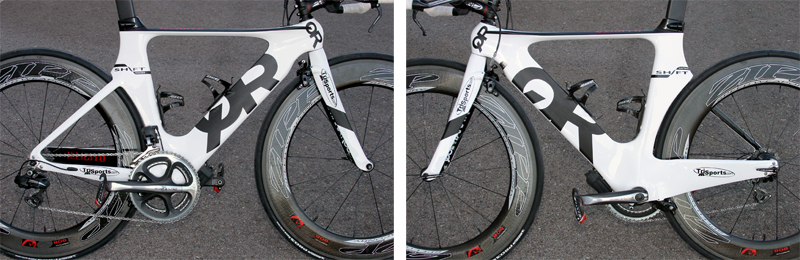
The Quintana Roo Illicito is different. The frame has no left seat stay. While the missing seat stay and massive left chain stay are the most visually striking features the SHIFT technology, improved carbon fiber lay-up, redesigned rear brake and BB30 bottom bracket also exert a strong influence on the bike's performance.

The lesson of history is that if you want extraordinary performance you must adopt extraordinary design.

The Illicito has not gotten much media attention mostly due to different industry emphasis and greater effort on product than marketing by Quintana Roo. QR has focused on the steak and not the sizzle. The logic of tossing the UCI rule book and designing a bike specifically for best aerodynamics makes sense- to triathletes. Lotus, Zipp, Softride, Trek, Kestrel and Hotta have all done it. The Quintana Roo Illicito, as the name suggests, is illegal for UCI sanctioned races like the Tour de France. For triathletes: who cares? It's designed to be faster, rules be damned. For QR designing a bike specifically for the triathlete is where they started in 1987. It excludes them from events sanctioned by USA Cycling and professional bicycle racing time trials governed by the UCI. In both politics and technology Quintana Roo walks the walk with the Illicito. They are truly 'True to the Tri' with the Illicito design. And of course, for triathlons the Illicito is entirely legal.

The Illicito is a natural evolution from the company that invented the original triathlon bike back in 1987.

Illicito was developed in the wind tunnel as are most aero bikes from Trek, Specialized and Cervelo. A major difference is that Quintana Roo invented this category: The aerodynamic triathlon bike. And, of course, Quintana Roo makes the claim that the Illicito has the lowest drag numbers where drag numbers matter most. I'm unapologetically cynical about wind tunnel drag numbers. Every manufacturer produces a 'white paper' that supports their sales agenda. On a practical level I will suggest these white papers are best used on a roll next to the loo since they are all purporting the same thing; 'Our bike is best!' They effectively cancel each other. But in the case of the Illicito something prevails: Logic. If the bike has missing frame sections, it ought to be faster simply by virtue of the fact that something is gone. If that is 'Exhibit A' then 'Exhibit B' is the UCI sanction of the Illicito.

The most conspicuous feature of the Illicito is the asymetrical rear end, but other aerodynamic designcues are less obvious such as QR's "SHIFT" orientation of the down tube.

And then there is the emerging anecdotal evidence. TriSports.com founder Seton Claggett can ride any bike, including brands TriSports.com currently doesn't sell. At Ford Ironman Arizona he rode Quintana Roo's Illicito. He had his fastest bike split ever, his fastest Ironman ever. A few weeks before that on his first race on the Illicito he had the fastest amateur bike split at a local event. While any one variable like a new bike can't be attributed with that success, it does track with the trend that Claggett made good equipment choices, trained effectively and executed a good race plan. The convergence was an age category win at Ford Ironman Arizona and a Kona spot.

We discovered the rear end on the Quintana Roo Illicito frameset was extremely stiff in out of the saddle climbs, largely due to the massive left chain stay and high end carbon fiber lay-up.

Because Tennessee based Quintana Roo doesn't have pockets as deep as Specialized and Trek, fortified by mountain bike and hybrid sales, we won't see Craig Alexander or Lance Armstrong on an Illicito. We will see an increasing number of age groupers on the bike from a live swipe of their own credit card- a more relevant endorsement than paid sponsorships.

The logic of the Illicito seems supportable: If you make a design that is tangibly different it will perform tangibly different. There is also an accumulating repository of solid results from people already on the bike. Those two factors merit attention.

If it is made differently, it will perform differently. The asymetrical orientation of the rear

triangle and the massive left chainstay are apparent in these photos.

The Quintana Roo Illicito is currently sold as a frame only. Quintana Roo said there are no immediate plans for a complete bike version. The good thing is you get to pick your own components; the bad thing is this is generally more expensive than buying a complete bike. At this level most customers want a degree of flexibility with components anyway so offering the Illicito as a frameset makes sense for dealers and consumers.

From the front of the frame to the back:

For all its conspicuous features the Illicito is mostly a bike of subtle technology. It starts with the fork. Quintana Roo developed the first aerodynamic fork with the Carbonaero in the late 1980's. Their fork innovation continues with the Illicito fork. The dropout protrude forward of the fork blades adding stability to the front end, a great feature for a bike designed to be ridden in the aero position. Viewed from the front the fork blades arch away from the front wheel dramatically. This aerodynamic feature allows the boundary layer of air to pass between the rotating front wheel and fork blades at lower pressure with less drag and turbulence. The brake is mounted behind the fork, another aerodynamic que. The new brakes have very good stopping power and are a conspicuous improvement over prior efforts.

The fork on the Illicito provides stable handling in the aero position and reduces the pressure of air

between the front wheel and the fork blades by maintaining a large gap from rotating spokes (right).

The head tube of the frame features a conical shape we've also seen on some Cervelo efforts like the P3. The downtube is a deep airfoil shape that harkens to Specialized's new Shiv. Top tube is a flattened shape parallel to the ground. There are two standard bottle cage mounts on the frame, one seat tube, one down tube. I appreciate this feature, rare on an aero frame bike.

Claggett's Ironman AG winning Illicito was controlled from a Shimano Dura-Ace Di2 control set mounted on a Profile "J" bend extension aerobar. Note the elegant cable inlets and Di2 integration on the Illicito frameset.

The cable inlets on Seton Claggett's Illicito were very nicely done Shimano Di2 specific and made for a clean, well conceived presentation. They also do a nice job of sealing out moisture from spilled sports drink and rain. In the case of Claggett's IM AG winning bike the Di2 battery is slung under the down tube. I'd like to see more aero integration of Di2 batteries on all aero bikes. A rumored 'Race Day' battery that is smaller may help resolve this in the next few months. For now Di2 battery mounting on every bike seems like an afterthought. Bike industry: The new coffee flavor is Di2, wake up and smell it!

Moving back on the frame you see the influence of Quintana Roo's 'SHIFT' design doctrine. The down tube angles off to the rider's right toward the crank. SHIFT technology is the first attempt at not only reducing bicycle frame drag, but also mitigating drag caused by the drivetrain. The downtube on a SHIFT technology bike sits 18mm closer to the drive side. It is claimed to 'shift' the boundary layer of air away from the drivetrain to the cleaner, non-drive side of the bike. SHIFT also seems to improve bottom bracket stiffness, a boon when climbing and accelerating. Several other manufacturers have trended toward an asymmetrical bottom bracket with SHIFT leading this trend. While the unique rear end design of the Illicito is the most visually striking the SHIFT technology may be the more effective aerodynamic design feature.

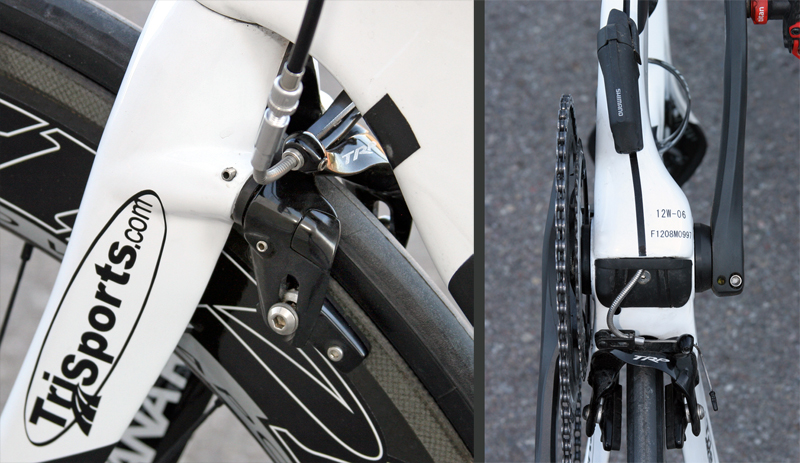
QR's greatly improved aero brakes from TRP. The right photo shows the asymmetrical orientation of

the down tube, improved rear brake and clean cable routing as well as the Di2 battery mount.

Rear bake on the Illicito is a massive improvement over previous under-bottom bracket brakes. The new TRP (Tektro Racing Products) 'U' brake has more powerful return springs, is easier to adjust and holds its center better than previous rear brakes which were, admittedly, quite poor. Another benefit with this brake is the capability to work with the wider aero wheels trending now like Zipp Firecrest, bulge disks and HED's new wider rims. The brake has more 'throw' and leverage to facilitate a more open position and better leverage. This is a great improvement.

Chainstays on the Illicito are wildly asymmetrical giving the bike a lot of visual punch. The thinking is the massive left seat stay provides structural integrity given up by removing the left side seat stay. When asked if a future bike could be built with this design completely replacing both seat stays Quintana Roo's spokesperson went awkwardly silent.

The eye catching rear end of the Illicito includes practical details like clearance for new wide aero

wheels, replaceable, adjustable dropouts and derailleur hanger.

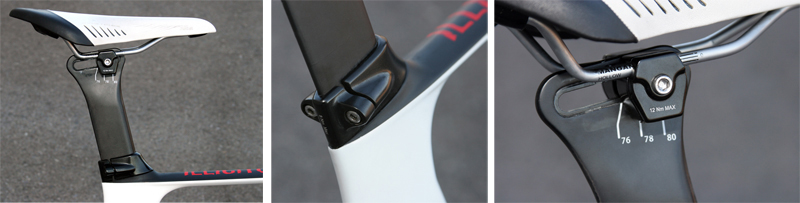
The rear dropouts on the Illicito are all alloy and very robust. They empty to the rear of the bike and are horizontal. At the top of the seat mast there is an alloy binder clamp that uses two bolts, another practical design feature.

One thing that struck me working with the new Illicito is that it is a superbike you can travel with. Most other aero bikes with substantial component integration might not work well going into a flight case and, if something goes wrong when you are at an 'away' race there may not be mechanics and parts on-sight to service the issue. With the exception of the brake calipers, the QR Illicito frame uses fairly standard fittings and fasteners.

Quintana Roo stayed true to their lineage with the fit and geometry of the Illicito since the bike can be ridden at an 80+ degree open seat tube angle. The head tube is a stable and comfortable 72 degrees across every size. Head tube height on the two smaller sizes, 'Small' and 'Medium' are a low 90 millimeters, tracking with Cervelo's P4 and P3 and Felt's 'B' and 'DA' bikes. There are four sizes in the Illicito called 'Small', 'Medium', 'Medium Large' and 'Large'. I am 5'9' and have a long torso so I would be on the 'Medium Large' with the 54cm top tube and the saddle in a forward orientation to open the angle between my torso and femur at the top of the pedal stroke. Seton Claggett, who prefers a more compact position and a slacker effective seat angle, rode the 'Medium' for his Ford Ironman Arizona Age Group victory.

QR stayed true to the tri with their steep angle geometry for a comfortable, open torso to let

position in the aerobars. Seat tube angle is adjustable through a wide range.

There have been a few bikes important enough to influence triathlon specific bike design- most have been from QR over the past few decades. The Quintana Roo Superform was the first to make a real impact on athlete performance and the market. The Illicito may be another. The Illicito puts Quintana Roo firmly back in the top ranks- if not at the very top- of triathlon bike innovation and performance.

Elements...I like their touch

A recent addition to my training and racing season this year, is regularly scheduling a massage. I used to get massage when things went south...sore muscles, strained muscles, etc. But I thought I would be more pro active this season and shoot for once a week. I know the benefits, but I just did not take advantage of them.

  • Increased blood flow
  • Increased joint range of motion
  • Increased flexibility
  • Increased elimination of exercise waste products- lactic acid
  • Decreased muscle tension
  • Increased relaxation of nerves
  • Ultimately, enhanced recovery for future training/building
  • Reduce injury

The north side Elements Therapeutic Massage is located near my house, so there is really no excuse since they are open ~ 11 hours a day, 7 days a week

Though they offer a variety of packages and types of massages, I normally get the deep tissue massage. If you have not had a deep tissue (more sports related), it's not about light touch and falling asleep. It's a "grit your teeth and try to relax" experience. Ya, I like a little torture in the week. But the advantages I have noticed are substantially less lower back issues, more flexibility in my hamstrings and I am bouncing back after the massage more quickly. Having a person tell me where some 'trouble' spots are that I can work on is super beneficial. The therapist is always able to find some 'hot spots' that do not seem to be too happy with me...go figure?

Wherever you choose to go, make it a part of your regular routine...just like intervals or endurance days...I think you will see the benefits quickly.


Friday, January 06, 2012

Candy for the road


Some new rides for the 2012 TIMEX Multisport Team. Pretty exciting! See yours at Fitness Fanatics in Spokane.